Essential Guide to Navigating the Pacific Northwest Interstates
The Pacific Northwest has stunning scenery, but its interstates are also some of the busiest freight corridors in the country. If you’re planning a PNW road trip in 2026, you need more than a full tank and a solid playlist.
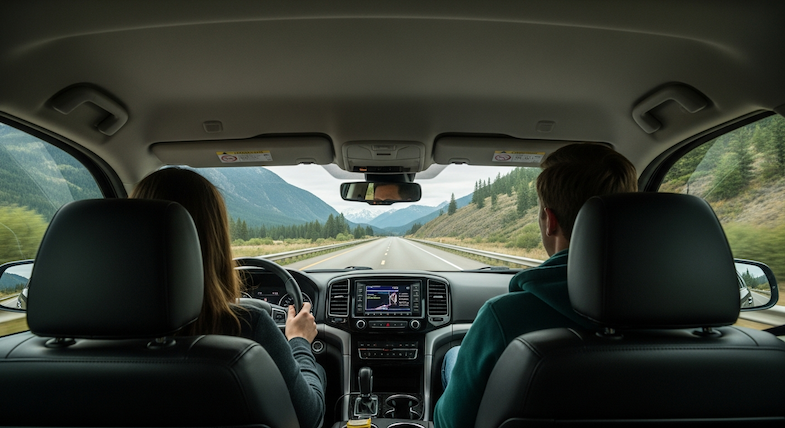
Sharing these highways with heavy commercial trucks, dealing with sudden mountain weather, and navigating constant construction zones all take real preparation. Think of it as a step up from tackling a Phoenix to Denver road trip; the stakes on I-5 and I-82 are higher than you might expect.
The 2026 Traffic Reality on I-5 and I-82
When the Interstate Shuts Down
Multi-vehicle pileups on PNW interstates don’t just ruin someone’s day; they ripple through entire supply chains. A recent crash shutting down northbound I-5 in South Portland delayed perishable goods and idled workers, costing regional logistics networks an estimated $420,000 per hour. That’s not just a trucking problem. It’s a sign of how fragile these corridors really are.
For you as a road tripper, one accident can turn a two-hour stretch into an all-day ordeal. Monitoring real-time traffic data and having backup routes planned isn’t optional on these highways.
High-Risk Commute Zones
Construction, maintenance, and sudden crashes regularly choke traffic across western Washington and Oregon. Major highway closures on routes like SR 520, I-90, and I-5 force significant detours, while incidents like a morning crash near Fife can shut down multiple lanes without warning.
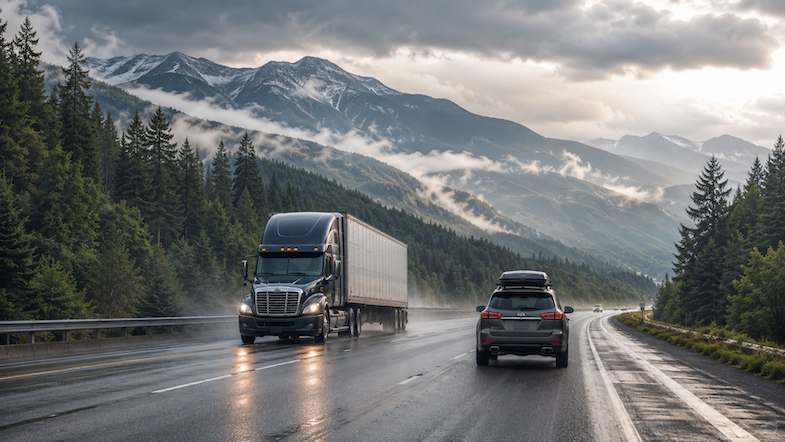
And it’s not just fender benders. Recent events include a deadly crash on US 2 north of Spokane and a fatal incident on I-90 near Liberty Lake. These corridors carry heavy commercial traffic, which raises the stakes for everyone on the road.
Sharing the Road with Heavy Freight
Stopping Distances and Raw Physics
Here’s a number that should stick with you: a fully loaded semi at 65 mph needs roughly 525 feet to stop. That’s 209 feet more than your car. Your vehicle simply can’t absorb the kinetic energy of a collision with an 80,000-pound tractor-trailer.
The stats tell a grim story. In fatal collisions between a large truck and a passenger car, 65% of the fatalities are car occupants. So what does that mean for you? Give trucks space. Lots of it.
| Metric | Passenger vehicle | Fully loaded commercial truck |
|---|---|---|
| Average weight | 4,000 – 5,000 lbs | Up to 80,000 lbs |
| Stopping distance (65 mph) | ~316 feet | ~525 feet |
| Primary blind spots | Immediate rear corners | Front (20 ft), rear (30 ft), left (1 lane), right (2–3 lanes) |
| Fatality risk in collision | 97% of fatalities | 3% of fatalities |
The “No-Zone” and Why It Matters
Ever heard of the “no-zone”? It’s the term for the large blind spots around a commercial truck where the driver simply can’t see you. According to FMCSA data, one in three collisions between large trucks and passenger vehicles occurs within a truck’s blind spots, also known as “No-Zones.” Furthermore, data from the Large Truck Crash Causation Study reveals that inadequate surveillance—where a commercial driver fails to check or properly scan their surroundings—is a critical factor in roughly 14% of all large-truck crashes.
A semi’s front blind spot extends about 20 feet, the rear stretches up to 30 feet, and the right side can span two to three full lanes. That’s a massive area where a truck driver has zero visibility.
Legal professionals who handle freight accident cases consistently stress the importance of staying out of semi truck blind spots. But you don’t need a lawyer to tell you this: if you can’t see the truck’s mirrors, the driver can’t see you. Pass quickly on the left, and never linger alongside a semi.
Mountain Passes and Weather Shifts
Rapid Elevation Changes
PNW driving can take you from sea level to a mountain pass in under an hour. That kind of rapid change brings real hazards. Northwest mountain passes are known for steep grades, sudden fog, landslide risks, and weather that can drop snow or heavy rain on the road with almost no warning.
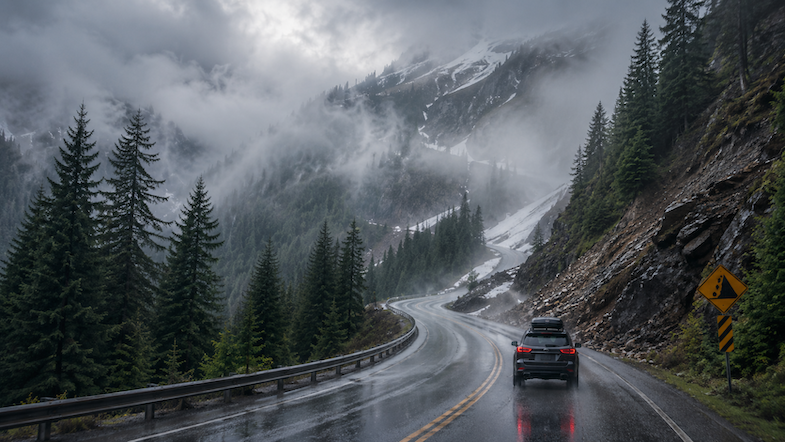
Tire traction can change dramatically within a few miles. Keep an eye on temperature gauges, road surface conditions, and weather forecasts before you climb. Sound familiar if you’ve driven high-altitude routes before? The PNW just adds rain and fog to the mix.
Collision Prevention on Dangerous Stretches
State agencies are actively working to cut the rate of fatal crashes on high-risk highways. After a series of deadly incidents on US-395, Washington agencies teamed up to improve driver education around merging and proper use of acceleration and deceleration lanes.
Here are some specific protocols worth building into your driving habits on PNW interstates:
- Use acceleration lanes fully. Match interstate speed before merging so you don’t force a truck into a panic stop behind you.
- Watch for sudden closures. Check real-time WSDOT data before heading onto high-altitude routes like the North Cascades Highway.
- Double your following distance in the mountains. Fog and drizzle can appear out of nowhere on pass roads. The standard three-second rule isn’t enough.
- Pass trucks decisively. Move past on the left and don’t linger in that right-side blind spot.
The Bottom Line for PNW Travelers
Pacific Northwest interstates are beautiful, but they’re working highways first. Heavy freight, volatile mountain weather, and congested corridors all demand your full attention.
Stay aware of the trucks around you, respect stopping distances, and never assume a commercial driver can see your vehicle. Plan for weather changes on mountain passes, keep backup routes ready, and check real-time traffic data before you hit the road. A little preparation goes a long way toward keeping your road trip safe and on schedule.
Mike Shubic





![Top-5 Best Places to visit in Belgium beyond Brussels [video included]](https://mikesroadtrip.com/wp-content/uploads/2020/07/Pin-6b.jpg)
![Top-10 Most Interesting Facts about Arizona [Video Included]](https://mikesroadtrip.com/wp-content/uploads/2020/07/Pin-2.jpg)